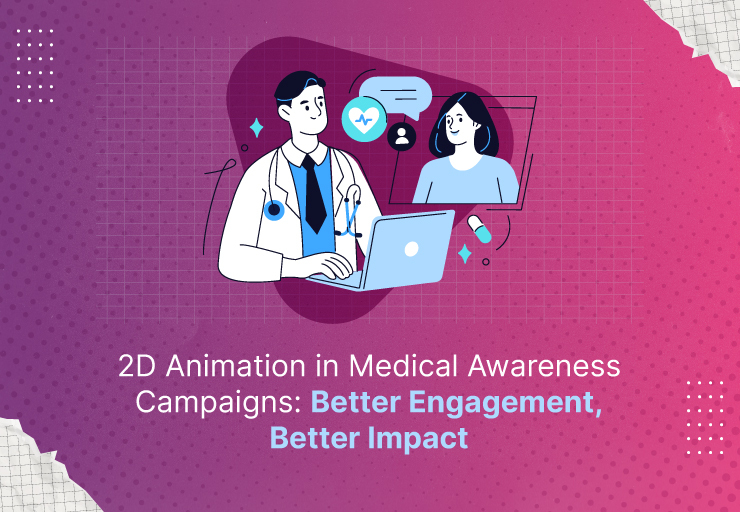
Public health initiatives often struggle to engage audiences due to their use of complex medical information. Which results in limited retention and poor behavior. For this reason, 2D animation can be used as a tool for simplifying complex medical information and increasing viewer engagement. Enhancing their ability to retain information. Additionally, examples from studies published in peer-reviewed journals based on actual product sales will help the reader understand this concept. The reader should walk away with an understanding of why 2D animation enhances information retention and improves outcomes.
Why 2D Animation Simplifies Complex Medical Info
2D animation allows the audience to see and understand complex subjects by converting them into animated 2D cartoons or images. The audience will have a clearer picture of how disease processes work and how medical professionals work. Research shows that 73% of clinical studies using animated videos reported an increase in patient understanding and retention of healthcare information.
Advantages of Medical Animation Versus Traditional Approach
- Visual Representation – Medical animation uses relatable characters and flows to help eliminate fear before a procedure.
- Language and Literacy Accessible – Medical animation provides a way for different public health audiences to access information regardless of their ability to read or speak English.
- Increased Retention – Studies show that people retain 65-75% more of what they see with a medical animation than what they read about in a text document.
Increasing Public Health Campaign Engagement
With so many people being bombarded by information every day, it is becoming increasingly more difficult to get people’s attention. Research has shown that 2D animations use vibrant, energetic colors in combination with the use of motion, sound, and humor help get people’s attention faster than lectures or other text-based information. As a result, it has been documented that public health campaign engagement rates have increased significantly when 2D animation is used, particularly in campaigns focusing on mental health education.
In addition to using medical animation as a method of creating engaging patient education materials, the medical animation market has a projected value of over $511.59 million in 2025 with a projected annual growth rate of 18.67%.
Additional Read:
How 2D Animation Helps SaaS Companies Cut Support Costs by 40%
Engagement Metrics from Research
2D vs Other Formats: Cost and Speed Edge
Furthermore, 2D vs. 3D has demonstrated the cost-effectiveness and speed of producing 2D animation. Due to the speed of production and the lower costs associated with 2D, it is possible to develop a product in a shorter time frame than would be feasible in a 3D production. Therefore, 2D animation has a significant level of clarity in illustrating information over the photo-realistic nature of 3D and is ideally suited for educational purposes.
Implementing 2D in Your Campaigns
The audience is an important element: the primary message of this information has to do with preventing injuries/treatments, and therefore, all storyboard and/or template designs should be focused on those messages. Video content (8-1 minutes in duration) should be created and made available via social media and on the website to allow maximum reach. To increase the chances of creating powerful, effective content, work with healthcare professionals to create accurate video scripts (on how-to) using Adobe Illustrator and Adobe Animate to get very good-looking results, and evaluate success through analytical metrics (view count, shares, etc.) and attitudes toward behaviour change ($ere survey data).
Conclusion
You should now have a clearer understanding of how, by converting public health content talking points using 2D animation, people who are exposed to medical-related video content recall that information at 73% higher rate than other methods (ex. flyers, pamphlets, etc.). Examples of campaigns are available at the NHS and Pfizer. The next steps for you to take are to run tests blind on your own organisation’s next health campaign.