You have decided to start a video podcast, so you need a podcast production. You have the topic, the guests, and the message. But there is one decision that will shape how every single episode looks, how long it takes to edit, and how professional your show feels to viewers, and most people make it without realizing it matters.
That decision is whether to shoot with one camera or multiple cameras.
A single camera is simpler and cheaper upfront. But a multi-camera setup is what separates a podcast that looks like a YouTube video from one that looks like a broadcast show. More importantly, it fundamentally changes what your editor can do with the footage and how long it takes them to do it.
In this guide, we break down exactly what a multi-camera podcast setup involves, why it matters for production value, and what it changes at every stage of post-production. If you are about to book a podcast shoot and are weighing your options, this article will make the decision clear.
What Is a Multi-Camera Podcast Setup?
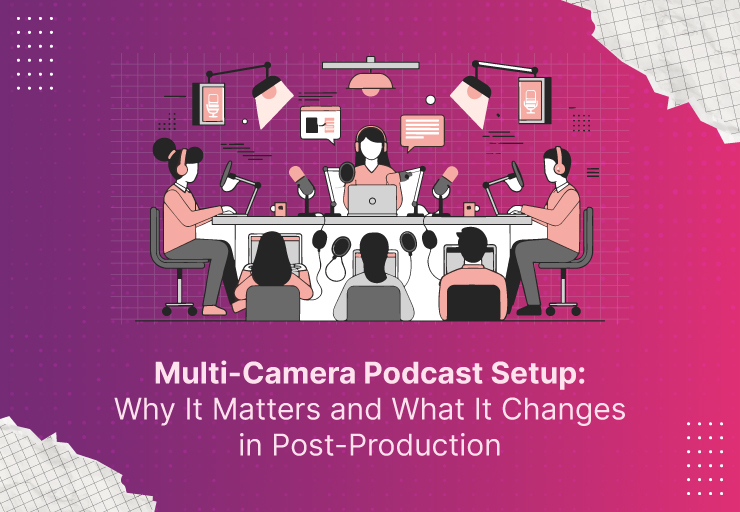
A multi-camera setup for podcasts means that when you record your podcast, you are using two or more cameras positioned at different angles to capture your podcast being recorded at the same time. A professional podcast recording usually has three cameras: a wide shot of both (or all) of the speakers in the same frame, a close-up shot of each speaker to capture their facial expressions and reactions, and a B-roll or detail camera to provide footage for any cutaway shots, product shots, or atmospheric shots you would like to include. All three cameras would be recording simultaneously throughout your entire podcast recording session, giving you a multi-track timeline as an editor to work with, versus one linear recording clip.
Additional Reading:
10 Reasons why video testimonials are crucial for businesses
7 Reasons Multi-Camera Setup Matters for Your Podcast
1. It Makes the Viewing Experience Actively Engaging
Human attention is drawn to movement and change. A single locked-off camera forces the viewer to stare at the same frame for 30, 40, or 60 minutes. There is no visual rhythm. With multiple cameras, your editor can cut between angles every 20–40 seconds, creating natural momentum that keeps viewers watching longer.
Why it matters at the decision stage: Watch time is the single most important metric on YouTube and Spotify Video. More camera angles = more cuts = better watch time.
2. It Lets Your Editor Fix Mistakes Without Jump Cuts
With a single camera, every edit is visible. If your host stumbles over a sentence, the editor has two options: leave it in, or make a jarring jump cut that everyone notices. With multiple cameras, that same stumble is invisible. The editor simply cuts to a different angle during the pause, making the fix seamless.
Why it matters at the decision stage: If your host or guests are not professional on-camera talent, multi-camera is not optional; it is essential protection against an unwatchable final cut.
3. It Captures Reactions, Not Just Responses
Some of the most compelling moments in a podcast happen on the face of the person who is listening, not the one who is talking. A guest’s nod, a laugh, a raised eyebrow, these are storytelling gold. With a single camera on the speaker, you lose all of it. With individual close-ups running throughout, your editor can choose the best reaction at any moment.
Why it matters at the decision stage: Branded podcasts live and die on authenticity. Reactions make conversations feel real. A talking-head single shot makes them feel like a presentation.
4. It Produces Short-Form Clips Automatically
Every episode you shoot should produce at least three to five short-form clips for LinkedIn, Instagram Reels, and YouTube Shorts. With a single-camera recording, those clips look exactly like what they are: a cropped segment of a longer video. With multi-camera footage, your editor can create clips that feel self-contained, visually dynamic, and platform-native.
Why it matters at the decision stage: If content repurposing is part of your podcast strategy, and it should be, multi-camera is the foundation that makes it work.
5. It Gives Your Brand a Consistent Visual Identity
The best podcast shows have a look. Think of any major video podcast you admire, the camera placement, the switching rhythm, the way close-ups are used during key moments. That visual consistency is not accidental. It is built at the shoot stage with deliberate camera placement and carried through in the edit. A single camera makes that kind of visual identity impossible to establish.
Why it matters at the decision stage: For B2B brands using podcasts to build authority, looking polished is non-negotiable. Your production values signal your brand values.
6. It Enables Batch Shooting Without Audience Fatigue
Most production-smart brands do not record one episode at a time. They batch record three to five episodes in a single shoot day. With a single camera, watching five back-to-back episodes creates visual monotony. With multi-camera footage, your editor can vary the cutting rhythm, angle selection, and pacing between episodes so each one feels fresh even when recorded on the same day.
Why it matters at the decision stage: If you are planning batch shoots, which we always recommend, multi-camera is what keeps your library from looking repetitive after episode three.
7. It Reduces the Number of Retakes You Need
Counter-intuitively, shooting with more cameras often means less time on set, not more. When you know your editor has multiple angles to work with, you do not need to stop and reshoot a segment just because someone blinked, looked away, or lost their train of thought. The coverage is there. The shoot flows. Guests feel more comfortable and natural, which shows on camera.
Why it matters at the decision stage: Studio time costs money. A multi-camera setup pays for itself in reduced shoot time and fewer re-records.
What Multi-Camera Changes in Post-Production
The impact of your camera setup does not end when the shoot does. Here is a clear breakdown of what changes in the edit suite when you go from one camera to many.
- Multi-track syncing. Every camera’s footage needs to be synced to a single audio master. Professional studios use a clapper or timecode to make this fast. Without it, syncing three cameras manually is time-consuming and error-prone.
- Colour grading across cameras. Each camera captures colour slightly differently. Post-production must colour-match all angles so the show looks consistent when cutting between them. This step does not exist in single-camera edits.
- Multicam sequence editing. Editors work in a multicam sequence, watching all angles simultaneously and switching between them in real time. This is a specific skill and a specific workflow — not every editor is set up for it.
- Increased storage and render time. Three cameras shooting 4K for a 60-minute episode generate significant footage. Your post team needs the storage, the computing power, and the time budgeted for it.
- More creative control in the edit. Your editor can now build energy, emphasise moments, and shape the viewer’s emotional experience in ways a single-camera editor simply cannot. The edit becomes storytelling, not just trimming.
The bottom line: Multi-camera post-production takes more time and requires more skill. Which is exactly why working with an agency that handles it end-to-end matters so much.
Single Camera vs. Multi-Camera: A Quick Comparison
- Visual engagement: Single camera — static. Multi-camera — dynamic.
- Mistake recovery: Single camera — visible jump cuts. Multi-camera — seamless cover cuts.
- Reaction capture: Single camera — one speaker at a time. Multi-camera — speaker and listener simultaneously.
- Short-form clips: Single camera — limited options. Multi-camera — platform-ready, visually varied.
- Post-production complexity: Single camera — simple. Multi-camera — requires specialist workflow.
- Brand perception: Single camera — entry level. Multi-camera — broadcast quality.
Conclusion
A multi-camera podcast setup is not a luxury upgrade. For any brand that is serious about using video podcasting as a long-term content and credibility strategy, it is the baseline standard.
The difference in production value is visible to every viewer, even those who could not name a single thing that makes it look better. They just know it does. And in a world where your audience has thousands of podcasts to choose from, looking like you mean it is part of the message.
The post-production implications are real: more cameras mean more footage, more syncing, more skilled editing, and more time. But when you work with a production partner who handles the entire pipeline, from shoot day through final delivery, those complexities are absorbed into a process that simply produces better results. If you are ready to start your video podcast the right way, KrishaStudio’s podcast production team handles everything: multi-camera setup, professional studio, post-production, and short-form clip creation